
The ResearchHunger Unit Converter is a free online tool designed to make measurement conversions simple, quick and accurate. Whether you are an engineering student, working professional, researcher or someone who regularly works with different measurement systems, this tool helps you convert values without performing lengthy manual calculations.
From converting millimetres into metres to changing kilograms into pounds or Celsius into Fahrenheit, you can perform multiple conversions using one convenient platform.
Simply select a measurement category, choose your starting and target units, enter a value and get your converted result instantly.
Unit Converter
Convert engineering and everyday measurements instantly.
Conversion ◎High
Accuracy ▱Multiple
Units
Select Conversion Category
ϟ Quick Presets:
▦Conversion Formula
ⓘAbout This Conversion
- 1 Millimetre (mm) = 0.001 Metre (m)
- 1 Metre (m) = 1,000 Millimetres (mm)
Conversions are calculated in your browser. No values or files are uploaded.
For standardised measurement definitions, you can also refer to the International System of Units (SI), maintained internationally and explained by the National Institute of Standards and Technology.
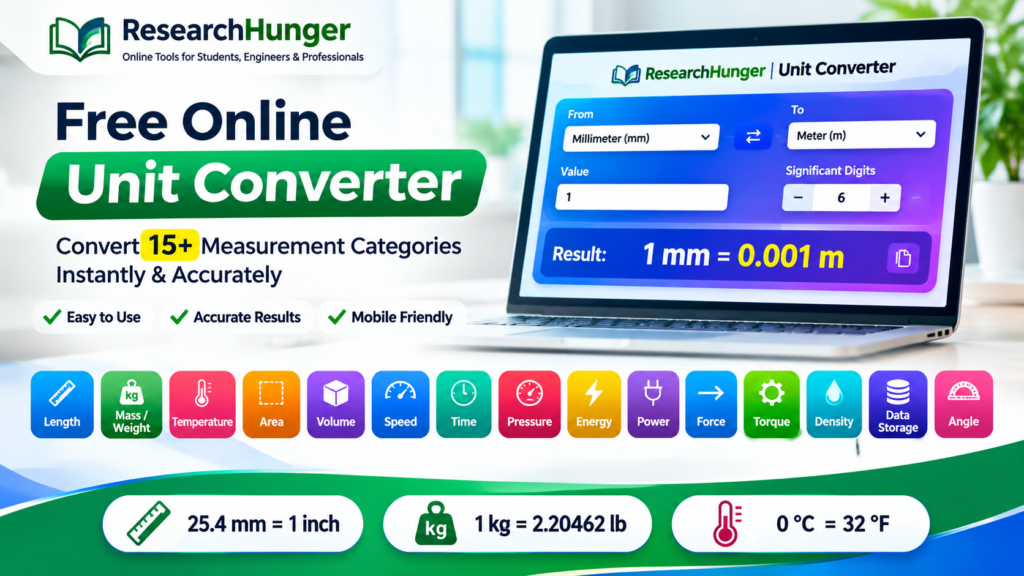
Available Unit Conversion Categories
Our online unit converter supports several engineering and everyday measurement categories.
1. Length Conversion
Length conversion is commonly required in engineering, construction, manufacturing and education. Convert between millimetres, centimetres, metres, kilometres, micrometres, nanometres, inches, feet, yards, miles and other supported units.
For example:
- 1 metre = 100 centimetres
- 1 kilometre = 1,000 metres
- 1 inch = 25.4 millimetres
2. Mass and Weight Conversion
Convert mass measurements between milligrams, grams, kilograms, tonnes, pounds and ounces. These conversions are useful in laboratories, manufacturing, transportation, packaging and everyday calculations.
For example, 1 kilogram is approximately equal to 2.20462 pounds.
3. Temperature Conversion
Temperature conversion is important in scientific experiments, industrial processes, weather measurements and engineering applications.
Convert between Celsius, Fahrenheit and Kelvin.
Common formulas include:
- Fahrenheit = (Celsius × 9/5) + 32
- Kelvin = Celsius + 273.15
4. Area and Volume Conversion
Area conversion is useful in land measurement, construction, architecture and industrial planning. Convert between square millimetres, square centimetres, square metres, hectares and acres.
Volume conversion helps with liquid measurements, tank capacity, storage and process calculations. Supported units include millilitres, litres, cubic metres and gallons.
5. Speed and Time Conversion
Convert speed measurements such as metres per second, kilometres per hour, miles per hour and knots.
The time converter helps you change milliseconds, seconds, minutes, hours and days into other supported time units.
These conversions are useful in transportation, machine cycle-time calculations, production planning and scientific applications.
6. Pressure, Energy and Power Conversion
Engineering calculations frequently require different units of pressure, energy and power.
Use the converter for supported units such as:
- Pressure: Pascal, kilopascal, megapascal, bar and PSI.
- Energy: Joule, kilojoule, calorie and kilowatt-hour.
- Power: Watt, kilowatt and horsepower.
These measurements are particularly relevant to mechanical engineering, electrical systems, fluid mechanics and industrial equipment.
7. Force, Torque and Density Conversion
Force, torque and density are important parameters in mechanical design and manufacturing.
Convert between Newton, kilonewton, kilogram-force and pound-force for force measurements. Torque conversions include Newton-metre, Newton-centimetre and pound-foot. Density conversions include kilograms per cubic metre and grams per cubic centimetre.
8. Data Storage and Angle Conversion
The converter also covers digital storage measurements such as bits, bytes, kilobytes, megabytes, gigabytes and terabytes, along with their supported binary units.
For angular measurements, convert between degrees, radians and gradians. These units are commonly used in mathematics, geometry, robotics and mechanical engineering.
How to Use the Online Unit Converter
Using the ResearchHunger tool is straightforward:
- Select the measurement category you want to convert.
- Choose the starting unit in the From section.
- Select the required target unit in the To section.
- Enter the numerical value you want to convert.
- View the converted result instantly.
- Adjust the significant digits to control the precision of the displayed result.
- Use the Swap option to reverse the selected units or Copy Result to copy your answer.
The tool is designed to make conversions convenient on desktop computers, tablets and mobile devices.
What Are Significant Digits in Unit Conversion?
Significant digits represent the meaningful digits used to express the precision of a numerical value.
For example, the value 2.50 contains three significant digits, whereas 2.5 contains two. Selecting an appropriate number of significant digits helps control how precisely a converted result is displayed.
For scientific and engineering calculations, selecting suitable precision is important. However, displaying more digits does not necessarily mean that the original measurement is more accurate.
Why Use ResearchHunger?
ResearchHunger aims to provide practical online tools that simplify everyday tasks and technical calculations.
Our unit converter offers:
- Free and convenient unit conversions.
- Multiple engineering and everyday measurement categories.
- Instant conversion results.
- Adjustable significant digits.
- Simple unit selection and swapping.
- Copyable conversion results.
- A responsive interface for mobile, tablet and desktop users.
- Browser-based calculations without uploading your conversion values.
You can also explore our other useful tools, including the Age Calculator, Scientific Calculator and the Calculators Collection.
Frequently Asked Questions (FAQs)
Is the ResearchHunger Unit Converter free?
Yes. You can use the online unit converter without paying a fee or creating an account.
Can I convert millimetres into metres?
Yes. Select Length, choose Millimetre as the starting unit and Metre as the target unit. Enter your value to see the converted result.
How do I convert kilograms into pounds?
Select Mass, choose Kilogram as the starting unit and Pound as the target unit. Enter the required value to obtain the result.
What are significant digits?
Significant digits indicate the precision with which a numerical result is displayed. You can adjust the significant-digit setting according to your calculation requirements.
Does the unit converter work on mobile phones?
Yes. The converter is designed with a responsive layout so that users can access its features on smartphones, tablets and desktop computers.
Do I need to download any software?
No. The converter works directly in your web browser. You do not need to install a separate application to perform conversions.
Start Converting Units Today
Make measurement conversions easier with the free ResearchHunger Online Unit Converter. Whether you need everyday conversions or engineering-related calculations, select your units, enter a value and get your result in seconds.